
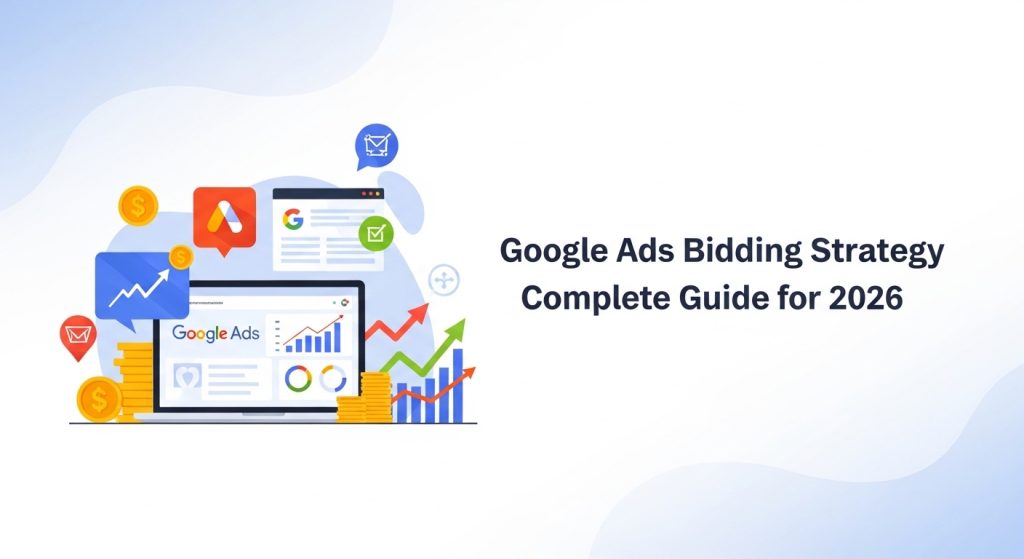
A successful digital marketing campaign begins with understanding Google Ads Bidding Strategy. At its core, a bidding strategy determines how your ads compete in the Google Ads auction, influencing whether they appear to your target audience and how much each click costs. Choosing the wrong strategy can lead to wasted budget, missed conversions, or poor ad visibility. On the other hand, a well-planned strategy aligns with your campaign goals—whether maximizing clicks, increasing conversions, or optimizing return on ad spend (ROAS). In 2026, automation and machine learning have transformed bidding strategies, making it easier for advertisers to target users effectively while minimizing manual effort. By mastering Google Ads Bidding Strategy, businesses of all sizes can improve ad performance, control costs, and achieve measurable results.
Types of Google Ads Bidding Strategies
Understanding the different types of Google Ads Bidding Strategy is essential for campaign success. There are three main approaches: Manual Bidding, Automated Bidding, and Smart Bidding. Manual bidding gives advertisers full control over their bids per keyword or ad group, ideal for precise campaigns. Automated bidding uses Google’s algorithms to adjust bids in real-time for clicks, conversions, or impressions. Smart Bidding, a subset of automated bidding, leverages machine learning to optimize for conversions or conversion value, including strategies like Target CPA, Target ROAS, and Maximize Conversions. Choosing the right strategy depends on your campaign goals, budget, and desired control level. In 2026, Google Ads continues to refine these strategies to make automation more efficient and results-driven.
How Google Ads Auction Works
Every time a user searches on Google or visits a Display Network site, an auction determines which ads appear. Google Ads Bidding Strategy interacts with this auction process to compete effectively. The auction considers the bid amount, Quality Score, ad relevance, expected click-through rate, and landing page experience. Advertisers do not pay more than necessary; they pay just enough to beat competitors in ad rank. Automated and smart bidding strategies optimize bids dynamically based on historical performance and predicted user behavior. Understanding the auction mechanics helps advertisers choose the right bidding strategy and improve ROI. Optimizing campaigns in alignment with these factors ensures that ads appear in prime positions without overspending.
Manual Bidding Explained
Manual bidding allows advertisers to set their own bids for each keyword or ad group. With this Google Ads Bidding Strategy, marketers can maintain precise control over how much they are willing to pay per click. It’s ideal for campaigns where data is limited, or certain keywords are highly valuable. The downside is that manual bidding requires frequent monitoring and adjustments to remain competitive, especially in competitive niches. Manual bidding also allows granular targeting by device, location, and ad schedule. By combining manual bidding with careful tracking, advertisers can maintain control over spending while optimizing for conversions.
Automated Bidding Strategies
Automated bidding removes the need for constant manual adjustments by letting Google’s algorithms set bids automatically. This Google Ads Bidding Strategy type works well for campaigns seeking efficiency and scalability. The algorithm uses historical data and signals such as device, location, time, and audience behavior to optimize bids. Popular automated options include Maximize Clicks, which focuses on getting the most clicks within a budget, and Enhanced CPC (ECPC), which adjusts manual bids to increase conversion probability. By leveraging automation, advertisers can focus on strategy and creative while the system optimizes performance, particularly in campaigns with multiple keywords or broad targeting.
Smart Bidding and Its Advantages
Smart Bidding is a subset of automated bidding designed to maximize conversions or conversion value. It uses machine learning to predict which clicks are more likely to result in meaningful actions. Popular strategies include Target CPA, Target ROAS, Maximize Conversions, and Maximize Conversion Value. Smart bidding adapts in real-time to user behavior, location, device, and time of day. The main advantage is that it reduces manual effort while optimizing for ROI. Advertisers can achieve better performance, particularly when campaigns have sufficient conversion data for Google’s algorithm to learn from. Implementing smart bidding correctly can lead to significant improvements in both cost efficiency and campaign outcomes.
Target CPA Strategy
The Target CPA (Cost Per Acquisition) strategy focuses on achieving conversions at a set cost per action. Google automatically adjusts bids to meet the target CPA for your campaign. It’s ideal for businesses prioritizing cost-efficient conversions. However, this Google Ads Bidding Strategy requires sufficient historical conversion data—Google recommends at least 15 conversions in the past 30 days. Target CPA allows businesses to maintain predictable acquisition costs while leveraging machine learning to bid optimally across auctions. With proper setup, Target CPA helps maximize the number of conversions without exceeding budget constraints.
Target ROAS Strategy
Target ROAS (Return on Ad Spend) optimizes bids to achieve a specific revenue-to-cost ratio. Advertisers must define their desired ROAS, e.g., 500% revenue per ad spend. Google then adjusts bids to maximize revenue while maintaining the target ROAS. This strategy is ideal for e-commerce campaigns and businesses aiming to balance revenue generation and ad cost. The downside is that unrealistic ROAS goals can reduce impressions and conversions. By analyzing historical campaign data, businesses can set realistic ROAS targets, helping them use this Google Ads Bidding Strategy to scale performance while maintaining profitability.
Maximize Conversions Strategy
Maximize Conversions focuses on getting the highest number of conversions within a daily budget. Google automatically adjusts bids in real-time to reach potential customers most likely to convert. This Google Ads Bidding Strategy is ideal for campaigns prioritizing volume over cost per acquisition. Advertisers can pair this strategy with target CPA for additional control. While it may result in higher CPCs, Maximize Conversions ensures budget efficiency by optimizing bids for potential conversions. This approach reduces manual effort and increases conversion opportunities for businesses looking to scale their campaigns quickly.
Maximize Conversion Value Strategy
Unlike Maximize Conversions, Maximize Conversion Value optimizes for revenue rather than the number of conversions. This Google Ads Bidding Strategy is particularly useful for e-commerce campaigns where individual transactions have varying values. Google uses machine learning to prioritize high-value conversions, balancing bids across ad groups to maximize overall revenue. Proper setup requires accurate tracking of conversion values via Google Ads Conversion Tracking. By leveraging this strategy, advertisers can increase profitability while maintaining budget efficiency, ensuring that campaigns are optimized not just for activity but for tangible business impact.
Enhanced CPC (ECPC)
Enhanced CPC adjusts manual bids to increase the likelihood of conversion. While advertisers set the base bid, ECPC modifies it in real-time using signals like device, location, and user intent. This Google Ads Bidding Strategy is a hybrid between manual and automated bidding. It offers more control than full automation while leveraging Google’s algorithm to improve conversion rates. ECPC is particularly beneficial for campaigns with limited historical conversion data, allowing advertisers to optimize performance gradually while retaining control over maximum bid amounts.
Choosing the Right Strategy
Selecting the right Google Ads Bidding Strategy depends on campaign goals, budget, conversion history, and business type. Beginners might start with Manual Bidding or Maximize Clicks, while data-rich campaigns benefit from Smart Bidding strategies like Target CPA or Target ROAS. Advertisers must also consider ad types (Search vs. Display), seasonality, and target audience. Testing multiple strategies and analyzing performance metrics ensures the chosen approach aligns with business objectives. A flexible approach that adjusts bidding strategies based on campaign performance is key to long-term success.
Optimizing Bid Strategies
Optimization is crucial for all Google Ads Bidding Strategy campaigns. Use performance data from Google Ads reports to adjust bids, refine targeting, and update ad copy. Consider bid modifiers for devices, locations, and audiences to maximize ROI. Regularly reviewing metrics like conversion rate, cost per conversion, and ROAS ensures strategies remain aligned with business objectives. Testing different bidding strategies on small budgets before scaling helps mitigate risks. In 2026, leveraging automation alongside human oversight creates a powerful combination for cost-effective, high-performance campaigns.
Common Mistakes in Bidding
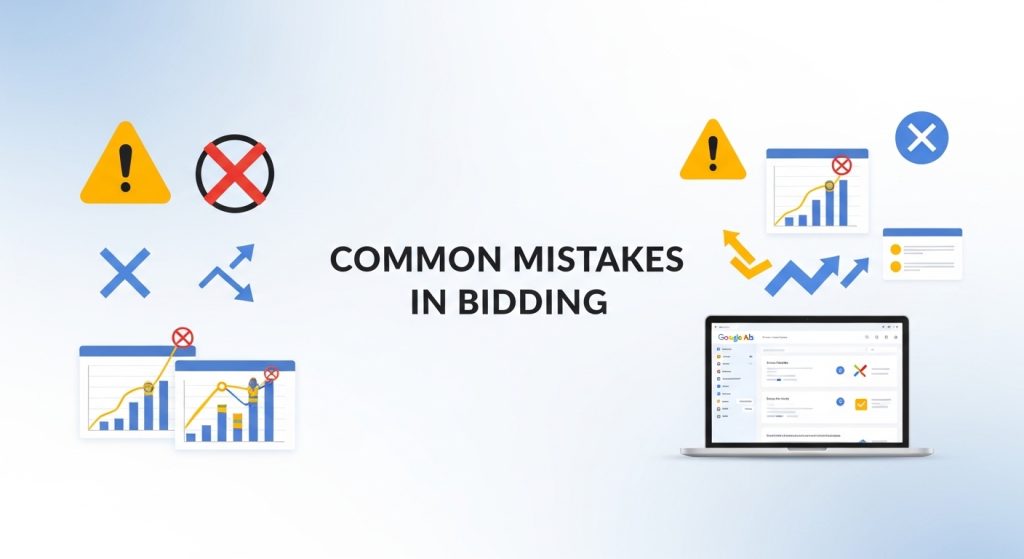
Many advertisers misuse Google Ads Bidding Strategy, resulting in wasted spend or lost opportunities. Common mistakes include over-reliance on automation without monitoring, setting unrealistic Target CPA or Target ROAS, ignoring bid modifiers, or not using conversion tracking effectively. Overcomplicating campaigns with too many conversion actions or not analyzing historical data can also hurt performance. Avoiding these pitfalls ensures campaigns remain cost-efficient, targeted, and effective. Proper understanding and careful monitoring of bidding strategies allow businesses to maximize the value of every ad dollar spent.
Future Trends in Bidding
The future of Google Ads Bidding Strategy is automation, AI, and machine learning. Algorithms will become smarter at predicting conversions and optimizing bids across devices, locations, and audiences. Integration with Google Analytics 4 (GA4) and Performance Max campaigns provides advertisers with deeper insights. Personalization and real-time adjustments will dominate, reducing manual effort and increasing ROI. Businesses adopting these trends early will maintain a competitive edge by leveraging data-driven strategies and predictive models to optimize bids efficiently while maximizing conversions and revenue.
Conclusion
Mastering Google Ads Bidding Strategy is crucial for any successful PPC campaign in 2026. From understanding auctions to choosing between manual, automated, and smart bidding strategies, advertisers can improve conversions, ROI, and campaign efficiency. Strategies like Target CPA, Target ROAS, and Maximize Conversion Value empower advertisers to align bidding with business objectives. Monitoring performance, avoiding common mistakes, and embracing AI-powered automation ensures long-term success. By combining knowledge, experimentation, and advanced tools, businesses can maximize ad spend, achieve predictable results, and grow sustainably.
FAQs
Beginners should start with Manual Bidding or Maximize Clicks, then gradually explore Smart Bidding as data accumulates.
Target CPA sets bids to achieve conversions at a specific cost, using machine learning to optimize bids in real-time.
Target ROAS optimizes bids to achieve a specific revenue-to-cost ratio, while Maximize Conversion Value focuses on increasing total revenue from conversions.
Automated bidding can improve efficiency, but monitoring and adjustments are necessary for optimal performance.
Use Google Ads Conversion Tracking, analyze ROI, ROAS, CPC, and conversion metrics regularly to measure effectiveness.