Local businesses today face intense digital competition. Many visitors explore a website, view products, or check services but leave without converting. That is exactly where a Facebook Ads Retargeting Strategy becomes powerful. Instead of constantly chasing new audiences, retargeting focuses on people who already interacted with your brand. Platforms like Meta Platforms built advanced advertising tools allowing businesses to reconnect with warm prospects. Through Meta Ads Manager, advertisers track behavior such as page visits, clicks, and video engagement. Consequently, businesses can deliver personalized ads that feel relevant rather than intrusive. Competitor analysis shows agencies and marketers increasingly prioritize retargeting because it reduces acquisition costs while improving conversions. Local restaurants, clinics, real estate agents, and service providers all benefit from strategic remarketing campaigns. Ultimately, mastering a structured Facebook Ads Retargeting Strategy helps local brands convert missed opportunities into paying customers.
Why Local Businesses Need Retargeting
Many local businesses invest heavily in traffic generation but fail to convert visitors immediately. Research across marketing agencies reveals that most users require multiple interactions before making a decision. Therefore, a strong Retargeting Strategy ensures prospects remain connected to your brand after their first visit. For example, a visitor who checks your services through Google Analytics may leave without contacting you. However, retargeting ads displayed on Facebook or Instagram remind them about your offer later. Competitors successfully use retargeting because it targets warm audiences instead of cold prospects. As a result, businesses experience higher click-through rates and improved return on ad spend. Additionally, local brands gain credibility through repeated exposure. Customers naturally trust businesses they see frequently. A consistent Facebook Ads Retargeting Strategy bridges awareness and purchase intent effectively.
How Facebook Retargeting Works
Understanding the mechanics behind a Retargeting Strategy simplifies campaign execution. Retargeting relies primarily on tracking technologies such as the Meta Pixel, which collects visitor data from your website. Once installed, the pixel records user actions including product views, add-to-cart events, or contact form visits. These actions automatically create custom audiences inside Meta Ads Manager. Businesses can then show tailored advertisements based on behavior. For instance, someone who visited a pricing page may receive testimonial ads, while another user who abandoned checkout sees discount reminders. This behavioral segmentation significantly improves conversion probability. Moreover, retargeting campaigns run continuously in the background, nurturing prospects without manual follow-ups. Competitor campaigns frequently combine website visitors, video viewers, and engagement audiences to maximize reach. When executed correctly, a structured Ads Retargeting Strategy turns anonymous traffic into highly qualified leads.
Types of Retargeting Audiences
A successful Ads Retargeting Strategy depends on choosing the right audience segments. Competitive analysis reveals that high-performing campaigns rarely rely on a single audience type.
Website Visitor Audiences
Users who visit landing pages represent strong purchase intent. Integrating platforms like Shopify or WooCommerce enables advanced tracking of shopping behavior.
Engagement-Based Audiences
Businesses can retarget people who interacted with posts, reels, or ads on Facebook and Instagram. These audiences already recognize your brand, making them ideal for follow-up offers.
Customer List Retargeting
Uploading email databases from tools like Mailchimp or HubSpot allows businesses to reconnect with existing leads and past customers. Combining multiple audiences strengthens your Ads Retargeting Strategy, ensuring broader yet relevant reach.
Setting Up the Meta Pixel Correctly
The foundation of every Ads Retargeting Strategy is accurate data collection. Without proper tracking, even the best creative campaigns fail to deliver results. Start by installing the Meta Pixel through your website’s header or using integrations available in Shopify, WooCommerce, or WordPress. After installation, verify events using Meta’s Event Manager to ensure accurate tracking. Experts recommend tracking key actions such as page views, leads, purchases, and button clicks. These events help Facebook’s algorithm understand user intent and optimize delivery automatically. Competitors often overlook testing, which leads to wasted ad spend. Therefore, validating pixel events before launching campaigns improves performance from day one. A properly configured pixel strengthens audience quality and makes your Facebook Ads Retargeting Strategy data-driven rather than guess-based.
Creating High-Converting Retargeting Ads
Even the best audience targeting fails without strong creative execution. Successful marketers design ads specifically for retargeted users rather than repeating cold-audience messaging. A well-built Facebook Ads Retargeting Strategy focuses on personalization. Show testimonials, limited-time discounts, or reminders based on previous actions. For example, users who watched videos should see deeper educational content instead of introductory ads. Design tools such as Canva help local businesses produce professional visuals without large budgets. Meanwhile, short video ads often outperform static creatives because they quickly capture attention. Additionally, use clear calls-to-action like “Book Now,” “Claim Offer,” or “Get Quote.” Competitor campaigns consistently emphasize urgency to drive conversions. When ad messaging matches user behavior, your Retargeting Strategy becomes highly persuasive and conversion-focused.
Retargeting Funnel for Local Businesses
A structured funnel transforms a basic campaign into a scalable Retargeting Strategy. Instead of running a single retargeting ad, successful businesses build layered funnels.
Awareness Retargeting
Target users who engaged with videos or social content. Introduce brand value and local credibility.
Consideration Stage
Retarget website visitors with reviews, case studies, and service demonstrations. Highlight social proof and customer success stories.
Conversion Stage
Show strong offers such as free consultations or discounts to people who visited contact pages or checkout screens. Competitor agencies frequently allocate budgets across funnel stages to maximize efficiency. As users move down the funnel, messaging becomes increasingly specific and persuasive. By structuring campaigns logically, your Retargeting Strategy guides prospects naturally toward conversion.
Budget Optimization Techniques
Managing ad spend efficiently is crucial for local companies with limited budgets. A refined Facebook Ads Retargeting Strategy typically costs less than cold targeting campaigns because audiences are already qualified. Start by allocating 20–30% of your advertising budget to retargeting. Many competitors prioritize retargeting first because conversion rates are higher. Monitor metrics like Cost Per Result and Return on Ad Spend inside Meta Ads Manager. Moreover, exclude recent buyers from campaigns to avoid wasted impressions. Frequency control prevents ad fatigue while maintaining consistent exposure. Testing different audience durations—7 days, 14 days, and 30 days—also reveals which users convert faster. Shorter windows usually deliver stronger intent signals. Through strategic allocation and continuous optimization, businesses maintain profitability while scaling their Facebook Ads Retargeting Strategy.
Dynamic Ads and Automation
Automation significantly enhances any Retargeting Strategy. Dynamic ads automatically display products or services users previously viewed, reducing manual workload. Ecommerce stores using Shopify or WooCommerce can upload product catalogs directly into Facebook. Once connected, Facebook dynamically matches products to user behavior. Automation allows businesses to retarget hundreds of products simultaneously without creating individual ads. Consequently, campaigns remain relevant and scalable. Additionally, automated rules inside Meta Ads Manager pause underperforming ads or increase budgets for winning campaigns. Competitors increasingly rely on automation to maintain performance consistency. For local businesses offering multiple services, dynamic creatives showcase relevant offerings automatically. This personalization improves user experience and strengthens overall campaign efficiency. Automation makes your Facebook Ads Retargeting Strategy smarter, faster, and more profitable.
Local Targeting Best Practices
Local businesses must combine retargeting with precise geographic targeting. A localized Retargeting Strategy ensures ads reach customers within service areas. Use radius targeting around your city or service zones. For example, restaurants, clinics, and real estate agencies benefit from location-based messaging emphasizing proximity and convenience. Including local references, customer testimonials, and neighborhood imagery builds familiarity. Competitor campaigns often integrate local language and regional promotions to increase engagement. Furthermore, scheduling ads during peak local activity hours improves performance. Service-based businesses typically see higher engagement during evenings and weekends. When retargeting aligns with local intent, users perceive ads as helpful reminders rather than interruptions. This localized personalization significantly strengthens your Facebook Ads Retargeting Strategy.
Measuring Retargeting Performance
Tracking performance metrics ensures long-term success. A data-driven Retargeting Strategy focuses on measurable outcomes rather than vanity metrics. Key indicators include conversion rate, cost per lead, click-through rate, and return on ad spend. Integrating Google Analytics with Facebook reporting provides deeper insights into user journeys. Competitors often analyze attribution windows to understand how long users take to convert after seeing ads. Short analysis cycles allow faster decision-making and optimization. Additionally, monitoring audience overlap prevents budget waste. Businesses should continuously refine segments based on performance data. Regular reporting transforms retargeting from experimentation into predictable growth. Measuring results consistently strengthens confidence in your Ads Retargeting Strategy.
Common Retargeting Mistakes to Avoid
Many businesses fail despite running retargeting campaigns because of avoidable errors. A poorly structured Facebook Ads Retargeting Strategy often results from lack of segmentation or repetitive messaging.One common mistake involves showing identical ads to all visitors. Different behaviors require different messaging. Another frequent issue is ignoring ad frequency, which leads to audience fatigue.Competitors also struggle when they forget exclusion audiences. Showing ads to customers who already converted wastes valuable budget.Additionally, weak creatives reduce engagement even when targeting is accurate. Updating visuals and copy regularly keeps campaigns fresh and effective.Avoiding these pitfalls ensures sustainable growth. With proper planning, your Ads Retargeting Strategy delivers consistent conversions instead of temporary spikes.
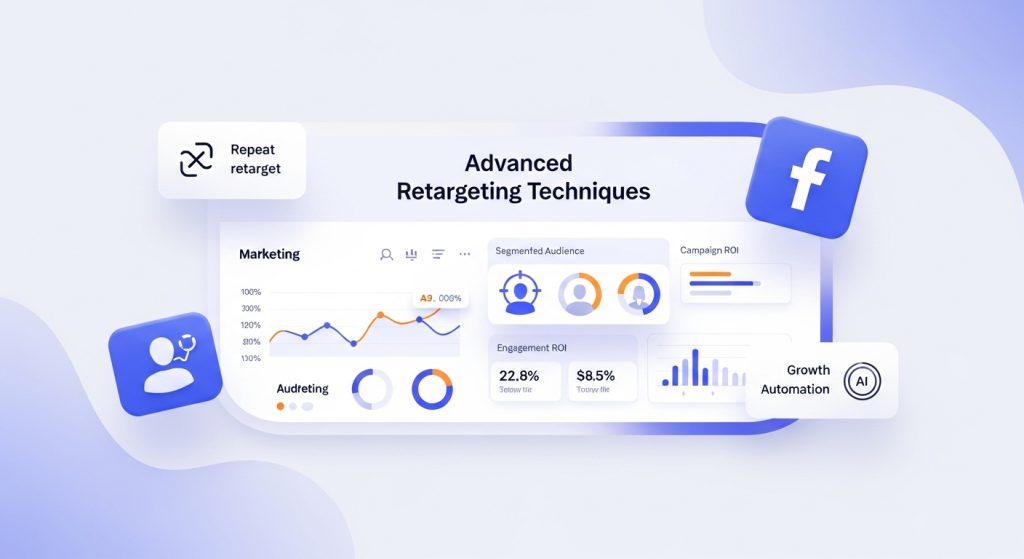
Advanced Retargeting Techniques
Once basic campaigns succeed, businesses can expand into advanced tactics. A sophisticated Retargeting Strategy leverages layered audience intelligence. Lookalike audiences built from retargeted converters allow scaling beyond existing visitors. Competitor agencies frequently combine retargeting with acquisition campaigns to maintain growth. Cross-platform remarketing also improves results. Users interacting with Tik Tok or YouTube can later be nurtured through Facebook retargeting campaigns. Sequential storytelling ads further increase engagement. Instead of repeating offers, show educational content first, then testimonials, followed by promotions. These advanced methods strengthen brand recall while improving conversion efficiency. Businesses adopting sophisticated strategies often dominate local digital markets through consistent retargeting excellence.
Future of Facebook Retargeting
Digital advertising continues evolving rapidly. Privacy updates and AI optimization are reshaping how advertisers approach retargeting. Despite changes, a strong Retargeting Strategy remains essential.Machine learning inside Meta Ads Manager now optimizes delivery automatically using behavioral signals. Meanwhile, first-party data collection is becoming increasingly important as tracking limitations grow.Competitor research shows businesses investing in CRM integrations and email marketing to maintain strong data sources. Combining owned data with platform intelligence ensures long-term sustainability.Video engagement and conversational ads are expected to dominate future campaigns. Local businesses adopting these trends early gain competitive advantages.The future favors brands that build meaningful relationships rather than aggressive selling. A strategic Ads Retargeting Strategy will continue driving local business growth in the years ahead.
Conclusion
Local businesses no longer need massive advertising budgets to compete online. Instead, success depends on reconnecting with people who already showed interest. A well-structured Ads Retargeting Strategy transforms website visitors, social media viewers, and past customers into loyal buyers.Throughout this guide, we explored audience segmentation, pixel tracking, creative optimization, funnel design, automation, and advanced scaling methods. Each element contributes to stronger engagement and higher conversion rates.Unlike traditional advertising, retargeting focuses on relevance and timing. Businesses communicate with users when they are most likely to act. Consequently, marketing becomes more efficient, predictable, and profitable.By consistently analyzing data, refreshing creatives, and optimizing audiences, local brands can build sustainable growth engines. Implementing a professional Facebook Ads Retargeting Strategy is no longer optional—it is a critical advantage for modern local businesses.
FAQs
A Facebook Ads Retargeting Strategy targets users who previously interacted with your business, helping convert warm audiences into customers.
Retargeting improves conversions, lowers advertising costs, and builds trust through repeated brand exposure.
Most businesses run continuous campaigns with audience windows between 7–30 days depending on buying cycles.
Yes. Retargeting often delivers higher ROI than cold advertising because audiences already know your brand.
Website visitors, video viewers, engaged social users, and past customers typically produce the best results.